ERcast: Clinical Perspectives Podcast Preview



The summary below is from an episode of ERcast: Clinical Perspectives
Direct oral anticoagulants have largely displaced warfarin because they are easier to use and carry less intracranial bleeding. The harder questions are renal disease, liver disease, breakthrough thrombosis, and when cost or valve pathology still makes warfarin the right call.
Choosing and dosing DOACs
- DOACs over warfarin: DOACs generally beat warfarin on practicality and safety, with a lower intracranial hemorrhage burden and less day-to-day INR volatility from diet and drug interactions.
- Renal disease reality: Dialysis is not an automatic reason to avoid a DOAC; apixaban is often workable, while warfarin can be especially difficult in ESRD because low vitamin K states destabilize INR control.
- Apixaban liver fit: Most patients with liver disease can still take apixaban, and Child-Pugh class B is the key zone where it remains the only DOAC commonly kept on the table.
- Dose reduction boundaries: Extended-phase VTE therapy can often step down after 6 months if the patient is stable, but atrial fibrillation and cancer-associated thrombosis generally stay on full-dose anticoagulation.
- Absolute DOAC exclusions: Mechanical heart valves, triple-positive antiphospholipid syndrome, and rheumatic valvular disease remain major reasons to avoid DOACs. We get into the practical why in the episode.
Breakthrough clot and follow-up
- Breakthrough clot framing: A recurrent clot on a DOAC is nonadherence until proven otherwise; the first move is a careful medication timeline plus anticoagulant levels when available.
- Missed dose red flag: Only one or two missed doses should still make you uneasy, because that pattern can justify pivoting to low molecular weight heparin rather than casually resuming outpatient therapy.
- Restarting after underdosing: If the patient has been underdosed or off therapy for a meaningful stretch and remains stable, restarting the original full-intensity DOAC regimen is often reasonable.
- Post PE syndrome: About half of patients have persistent chest pain or dyspnea for months after pulmonary embolism despite clot resolution, a pattern worth validating rather than reflexively labeling treatment failure.
- Symptom timeline counseling: Post-PE symptoms can last up to a year even with a reassuring echo, and that counseling point alone can prevent a lot of unnecessary alarm. We cover the bedside language in the chapter.
When warfarin still matters
- Cost-driven warfarin use: The strongest modern indication for warfarin is sometimes affordability, because an effective drug the patient cannot obtain is not an effective anticoagulation plan.
- Access before prescribing: If warfarin is the only viable option, reliable transportation and quick access to INR follow-up are mandatory practical checks before discharge.
- DOAC affordability workarounds: Pharmacists, social workers, and manufacturer copay programs can salvage DOAC access more often than clinicians assume, and low molecular weight heparin may be the cheaper fallback in some settings.
- Long-term warfarin costs: Warfarin brings hidden burdens beyond INR checks, including greater osteoporosis risk over time and more medication and diet interference than DOAC therapy.
Subscribe to ERcast: Clinical Perspectives to listen to the episode.
References:
- Ashraf H, Agasthi P, Shanbhag A, et al. Long-Term Clinical Outcomes of Underdosed Direct Oral Anticoagulants in Patients with Atrial Fibrillation and Atrial Flutter. Am J Med. 2021;134(6):788-796. PMID: 33444586.
- Connolly SJ, Karthikeyan G, Ntsekhe M, et al. Rivaroxaban in Rheumatic Heart Disease-Associated Atrial Fibrillation. N Engl J Med. 2022;387(11):978-988. PMID: 36036525.
- Eikelboom JW, Connolly SJ, Brueckmann M, et al. Dabigatran versus warfarin in patients with mechanical heart valves. N Engl J Med. 2013;369(13):1206-1214. PMID: 23991661.
- Martin KA, et al. Use of direct oral anticoagulants in patients with obesity for treatment and prevention of venous thromboembolism: Updated communication from the ISTH SSC Subcommittee on Control of Anticoagulation. J Thromb Haemost. 2021;19(8):1874-1882. PMID: 34259389.
- Pengo V, Denas G, Zoppellaro G, et al. Rivaroxaban vs warfarin in high-risk patients with antiphospholipid syndrome. Blood. 2018;132(13):1365-1371. PMID: 30002145.
- Siontis KC, Zhang X, Eckard A, et al. Outcomes Associated With Apixaban Use in Patients With End-Stage Kidney Disease and Atrial Fibrillation in the United States [published correction appears in Circulation. 2018 Oct 9;138(15):e425. PMID: 29954737.
- Vinding NE, Butt JH, Olesen JB, et al. Association Between Inappropriately Dosed Anticoagulation Therapy With Stroke Severity and Outcomes in Patients With Atrial Fibrillation. J Am Heart Assoc. 2022;11(6):e024402. PMID: 35229642.
Faculty
- Tom Deloughery, MD
Tom Tom DeLoughery is a native Hoosier who graduated from Indiana State University in 1981 (one year after Larry Bird) and from the Indiana University School of Medicine in 1985. He completed his internship at the University of California, Irvine before traveling to Oregon, where he finished his internal medicine residency and hematology/oncology fellowship. He has served as a professor of medicine, pathology, and pediatrics, with roles spanning hematology/oncology and laboratory medicine, and has contributed extensively to clinical care, research, and medical education. His clinical and academic interests focus on blood disorders, including hemostasis and thrombosis, areas in which he has written widely and taught at national and international levels. He also has an interest in the hematologic aspects of sports and travel medicine and has served on the board of directors of the Wilderness Medicine Society, where he chaired the research committee. He is a Master of the American College of Physicians and a Fellow of the Academy of Wilderness Medicine.
- Tiffany Proffitt, DO
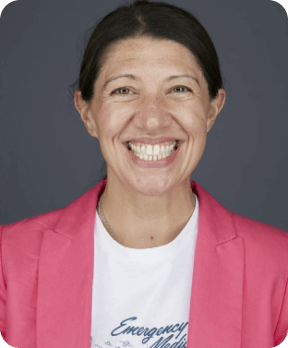
Dr. Proffitt is a board-certified Emergency Medicine physician practicing in Scottsdale, Arizona. She completed her medical training at Midwestern University Chicago College of Osteopathic Medicine and found her passion for medical education during her residency at Spectrum Health Lakeland. Tiffany is the co-founder and co-chairwoman of the HonorHealth Women Physicians Leadership Council, where she works to enhance professional development for 550 women clinicians. When she isn’t in the ED or podcasting, she’s chasing twins, dancing with toddlers, and enthusiastically singing the wrong lyrics to every song.